
Community Meals Wednesday, February 11th
We are looking for volunteers to help set up/serve & clean up after the meal, and/or buy/make food & desserts for the event.
Sign up at: https://www.signupgenius.com/go/70A084CA5A62BA57-61939878-community#/
We are looking for volunteers to help set up/serve & clean up after the meal, and/or buy/make food & desserts for the event.
Sign up at: https://www.signupgenius.com/go/70A084CA5A62BA57-61939878-community#/


The Protest History of the United States is a book by Gloria J. Browne-Marshall, a Constitutional Attorney at SUNY. She was a key presenter at the UU General Assembly last year. We have a link for an audiobook and those who wished to purchase books have done so and we are ready to begin. We can also get more books as you do not want to miss out on this conversation. The book is available through our public libraries in addition.
With consideration of driving at night and winter conditions, we are offering a comfortable day time meeting on Fridays from noon until 2. You will be encouraged to do a brown bag lunch or we can have lunch brought to us, as you wish.
Dates
February 20- chapter 1
February 27- chapters 2 and 3
March 6- chapters 4 & 5
March 13- chapter 6, 7 and 8
From noon to 2 pm

It is said that football is a game of inches. Look back on nearly any game and if you could
control two feet of the motion of the football, sometimes two inches, and you would control not
only games, but legacies.
Moments in sports get remembered and made sacred in ways that almost feel divinely fated.
They are not divinely fated. However, in life like in football, you never know what will or what
will not make a difference.
As we head to another Superbowl, Serious Patriots fans know that
If…Adam Vinatieri’s foot was moved two inches one way or another on any of his famous kicks;
Or…Brady’s arm was two inches further forward in the tuck rule game against Oakland;
Or…Belichick decided to punt on the famous the 4 th and 2 call against Indianapolis,
Or…In 2000 Tom Brady had been picked by any one of the 198 teams that passed him over,
Or…Drew Bledsoe had not gotten injured in that Jet game,
Or…in 2007 the ball David Tyree caught on his helmet in the Giants game slide off,
Or…In 2011 cornerback Asante Samuel had squeezed his hands a little quicker and intercepted
that ball, and football history changes.
And with those small changes a bit of our regions sense of self changes.
Sorry if that was a lesson available to only serious Patriot fans. However, the broader point
is available to everyone.
In life like in a football game, you never really know what will or what will not make a
difference. Football teaches us that there are moments in our lives that just immensely matter.
The wrong or right answer at a job interview, which of a woman’s eggs is the one that gets
fertilized, the flinch or not during a sneeze when you’re driving your car, or running into
someone at TJ-Max who you end up marrying.
We UU’s know this too. In our little religion that has ironically chosen not to take a position on
anything supernatural we can’t clearly see, have adopted the position that the future is open,
unwritten.. The old fashioned way we phrase it is “that revelation is not sealed.”
We, who shutter to say anything definitive about God or the heavens, or even the lack there of,
believe that our fates are not fixed. In a religion that has proven itself not only reluctant but
unwilling to say anything that would confine the view of any member, boldly state that it is
obvious that there is no book that can or has forecast the future. It is rare for a religion to adopt
such a position. And this means a lot.
It means of course that we as a church or movement could either blossom or fail. Both are
possible. That any of us or our programs could change the face of this town we live in, or not.
That we could fall apart and disband or catch fire and find ourselves with full pews.
Interestingly, reason also tells us that most likely our church, and our families, and our very lives
will have futures that are more likely determined by the level of attention, care and concern that
we give them.
Are not the present Patriots not an example of this.
By saying that revelation is not sealed we are saying that more than any religion ever before
that…our fate is in our hands, Nationally, locally, and within our very own church community.
Let’s embrace that.

There is a famous- historically inaccurate-but nonetheless mythically accurate scene in
UU/American history where Ralph Waldo Emerson goes to the local jail to bail out his friend
Henry David Thoreau. You may be familiar with it.
Thoreau, and this part is true, was arrested and placed in jail for refusing to pay his taxes as a
protest of the Mexican American War. A war he felt was an expression of America’s worst
expansionist and oppressive instincts.
In a play mythologizing the moment, Emerson asks his dear friend Thoreau what he is doing in
there, (referring to jail) to which Thoreau retorts, something to the effect… “My dear Waldo,
what are you doing out there?” Those are not the exact quotes, brought to life by a famous play,
but it captures the twist.
In an essay written shortly after his short time in jail Thoreau captured his opinions quite clearly.
In an essay that has come to be known as “Civil Disobedience.” he says
“Under a government which imprisons any unjustly, the true place for a just man is also a prison.”
That sentiment captures this moment we are in right now. Right now in ways that continue to
stymie and dismay.
We as a nation don’t want to fully support Ukraine, who was unjustly invaded by the Soviet
Union, but, we will actively bomb and capture the leader of a nation like Venezuela who
although corrupt, happens to have a lot of oil.
We risk setting the precedent of ICE officers NOT being held accountable for the murder of the
people they are attempting to apprehend, at the exact same time we are looking to force another
independent country to sell us Greenland.
Disgusting.
On an earth that desperately needs to begin cooperating in order to save future generations from
a fast eroding climate, we have an administration concerned about a new national expansionism,
renewing its old racism, and led by a man who read and re-read Hitler’s Mein Kampf.
Unacceptable.
I, likely along with you, are waiting for a moment …the moment when America will again
choose to return to its best side, it’s morally expansionist side that always has the potential for.
Maybe the death of Renee Good will be that moment.
I know that I am a minister, and we are a church that is mandated to avoid engaging in partisan
politics. However, it is more than a deeply set tradition and precedent within our religious
heritage to stand up to any and every organized effort to challenge our most deeply held norms
and values. And that is sadly where we are.
We must fight against the forces that want to define the world in ways that violate our
commitment to truth. Which is exactly what they want to do.
We must fight for the inherent worth and dignity of all people. For that is largely the norms they
are trying to undermine
We must not cower to those who wish to undermine democratic principles, rules, and norms.
For that is what is underway.
And, we must not fail to speak up for our inherently interconnectedness. Because, that is what is
seen as the enemy of those in power.
May we be that church and those people who don’t bow, and who aren’t silent.
Thank you for all you are doing. Don’t stop.
Rev. Steve
On this day in 1846, Henry David Thoreau left his cabin at Walden Pond
brief walk into town and ended up in the Concord jail for refusing to pay his poll
tax. A fervent abolitionist, Thoreau explained, “I cannot for an instant recognize .
. . as my government [that] which is the slave’s government also.” The next
morning, he learned that someone had paid the tax. He never knew who.
Although Thoreau objected, the constable insisted on releasing him. This
experience led him to write a powerful lecture on the “relation of the individual to
the State.” The lecture was published in 1849 as “Resistance to Civil
Government,” and is now known as “Civil Disobedience.” This masterful essay
has influenced generations of activists, including Mahatma Gandhi and Dr.
Martin Luther King, Jr.
Other than a rowboat and his books, he owned
almost nothing. He boarded mostly with his
family, and on several occasions, with the
Emersons.
Henry David Thoreau was on an errand in town when he encountered Sam
Staples, the Concord constable, tax collector, and jailer. Staples took the
opportunity to ask Thoreau to pay his back taxes. The independent-minded,
highly principled naturalist refused, and Staples politely escorted him to jail.
“The best place for each is where he stands,” Thoreau once wrote. When he found
himself incarcerated, he took full advantage of the new experience. Fascinated, he
“pumped” his cellmate for “the history of the various occupants of that room
[and] found that even here there was a history and a gossip which never
circulated beyond the walls of the jail.” The next morning, his fellow-prisoner was
sent “to work at haying in a neighboring field,” while Thoreau was told he must
leave the jail.
It was not the brevity of his stay that angered him but the interference with his
act of conscience and the fuss it caused. For the past six years, he had refused to
pay the poll tax (imposed on all males 20 to 70 years old) to protest the
institution of slavery. To his great annoyance during his short stay in jail,
someone paid it for him.
. . . he “pumped” his cellmate for “the history of
the various occupants of that room [and] found
that even here there was a history and a
gossip which never circulated beyond the walls
of the jail.”
Thoreau’s mother and sisters were active in the Women’s Anti-Slavery Society of
Concord, founded in 1837, and he had long been involved in the anti-slavery
movement, but he preferred to protest through individual action. His family
sheltered a number of fugitive slaves, and he would escort them to the next safe
house or to an out-of-the-way train station. He delivered powerful lectures
against slavery. And he withheld his taxes.
As he later wrote in “Civil Disobedience,” he believed “it is not a man’s duty, as a
matter of course, to devote himself to the eradication of any, even the most
enormous wrong; he may still properly have other concerns to engage him; but it
is his duty, at least, to wash his hands of it, and . . . not to give it practically his
support.”
Henry David Thoreau always had “other concerns to engage him.” Born in
Concord on July 12, 1817, he attended school there, and except for short trips,
primarily in New England, rarely left the town he described as “the most
estimable place in all the world.” After graduating from Harvard in 1837, he
taught school for three years and then joined his father at the family pencil
factory.
Exceptionally practical and resourceful, Thoreau improved pencil lead by baking
the graphite mixture into cylinders and invented a machine that drilled a hole in
the wood so the lead cylinder could simply be slipped in. John Thoreau &
Company pencils were considered the best on the market. But once Henry had
mastered the problem, he moved on. Life, he declared, “is too valuable to put into
lead-pencils.”
“. . . it is not a man’s duty, as a matter of
course, to devote himself to the eradication of
any, even the most enormous wrong; . . . but it
is his duty, at least, to wash his hands of it,
and . . . not to give it practically his support.”
Having never married, Henry Thoreau could choose not “to keep pace with his
companions,” and, indeed, he heeded “a different drummer.” He kept his needs
simple. Other than a rowboat and his books, he owned almost nothing. He
boarded mostly with his family, and on several occasions, with the Emersons.
When he ran out of money, he took a paid job until he was flush again. He could
always find work as a surveyor, and he was a skilled carpenter. “He chose to be
rich,” wrote his friend Emerson, “by making his wants few and supplying them
himself.”
On July 4, 1845, Thoreau moved into the one-room cabin he had built on land
Emerson owned on the shores of Walden Pond. “I went to the woods,” he wrote,
“because I wished to live deliberately, to front only the essential facts of life, and
see if I could not learn what it had to teach, and not, when I came to die, discover
that I had not lived.”
In the months that followed, he worked in his two-and-a-half-acre vegetable
garden, rowed his boat, and observed the smallest details of nature around him.
He read, walked, and wrote A Week on the Concord and Merrimack Rivers and
the first of seven drafts of Walden. He received visitors often and was himself a
frequent dinner guest at his parents’ or friends’ homes. Besides his one-night stay
in jail, his time at Walden was interrupted by a trip north into the Maine forests.

Videl Leins is a proud staff sergeant with 16 years of Air Force service and named plaintiff in the Shilling v. United States federal lawsuit, challenging the constitutionality of the Trump administration ban on military service by transgender people.
While the ban was initially blocked in March 2025 by the US District Court for Western District of Washington, the Supreme Court allowed it to take effect in May. The case is now pending ruling of the U.S. Court of Appeals.
The policy currently remains in effect, threatening thousands of transgender service members who have served with honor and distinction, including the seven active-duty plaintiffs in the case who collectively have over 115 years of military service.
Come for a first-person account of this discriminatory ban and its devastating effects from one of the named plaintiffs in this court case, Staff Sergeant Videl Leins, in conversation with activist Chrissi Bates (https://linktr.ee/chrissibates).
This event aligns with Unitarian Universalist principles of the inherent worth and dignity of all persons, and the rights and responsibilities of conscience, democratic process, justice, and truth seeking.
Read more about the case at https://lambdalegal.org/case/shilling-v-trump/

50 people showed up for our silent vigil for Renee Good and others who have been harmed and died in ice custody. We read the names of 30 people who are just some of the people who have died. Rang the bell at the beginning and end of our gathering. ❤️

All are welcome to join a silent vigil of remembrance for Renee Nicole Macklin Good, a Minneapolis resident and volunteer legal observer who was apparently murdered on Wednesday, January 7th by a federal immigration enforcement agent. As we grieve the loss of an American citizen dedicated to caring for and protecting the right to due process of others, we also honor the many lives harmed or lost in the course of unjust detainment and detention over the past year.
Please gather in front of the First Parish Unitarian Universalist Church, 40 Church St, Northborough at 6 pm, and bring a candle or light to hold.
I realized only in hindsight that giving anything the title “I had a dream too” as we
head into the MLK holiday had its own bold, potentially disrespectful
connotations. Nonetheless, the dream I had a couple weeks ago has nothing to do
with ending injustice, race, or the best aspirations humanity might rally to this time
of year. I share, my weird dream because it does have to do with how
miraculously marvelous, we can be.
See, my dream was a real dream that took place somewhere between 5:20 and 7am
on a recent Thursday morning. What happened between my ears that morning
reminds me of how miraculous all our minds are. I thought I would share it.
In that stretch of REM time, I found myself dreaming that I was both creating a
movie, in the way a director does, and one that I simultaneously found myself
watching it. Don’t ask it was a dream. It starts with a very Matthew Broderick
like lead character trying to de-fog his car window with his sleeve while driving.
FYI- I do this hasty task myself from time to time.
Anyway, in this movie, Broderick (unable to fully see through the glass) watches
his car slide slowly off a snowy road, up, and then over the crest of a beautiful long
hill near a house. I remember there being a comic absurdity to how far Matthew
Broderick drives off the road. In this movie/dream scene we never really see the
end; I presumably crash rather peacefully to a halt that again we never see.
Somehow, wordlessly, this is the point in my mental movie that I, its very author
discover to be a comedy. How one can surprise oneself in a dream that we
ourselves create is pretty amazing.
The next scene my mind entertained myself with involved the introduction of a
character that seemed to be Matthew Broderick girlfriend. She was played by
Christa Miller, the brunette actress who played Kate on the Drew Carey show. (I
remembered after waking that I had watched a speck of that show in re-runs just
two nights before). I have a little crush on her.
In scene two, we find her lying face down in an uncomfortable prone position in
the cab of an old truck. She is trying to fix something under the dashboard so she
can leave Matthew Broderick and go live on the Northern Coast, presumably
somewhere like Northern Washington. I don’t know how this news is conveyed to
the audience, only that in my dream I understood it as her goal. Moreover, I have
no idea what any of it means, it is a dream after all.
Anyway, in the next scene in my dream/movie we find her beginning to be
harassed in a comical over the top way by a low-grade moronic cop played by the
scruffy but affable Ryan Reynolds. I’m not kidding these actors were in my dream.
Why? I’ll never know. It’s a dream. Who do I look like Carl Jung?
In this scene there was a funny encounter, and a disagreement between them.
Frustrated by their encounter, Drew Cary’s Kate proceeds to ignore his plea that
she should leave the truck and returns back to uncomfortably lying down head
under the dashboard to fix something. We never see what?
The conclusion of this scene involves the rube cop Ryan Reynolds duck-taping the
doors and windows of her truck so solidly that she cannot easily get out.
Interestingly, I had just watched a PBS program on the ingenuity of honey badgers,
and this scene with the tape was reminiscent of something they did. However,
again, I have no idea why my mind took me on this journey. Nobody does, or
likely ever will. It was a dream.
This is not about foggy car windows, Duct tape, or TV crushes. It is about the
capacity of our brains, which as far as we can tell seem to be the crown of creation.
I woke up shortly after that. Pleased, amazed, wanting to remember and really
share the marvel of just how cool it is that we have such imaginative capacity built
into our very bodies.
So, somehow in that early morning in a way nobody can explain, I was watching a
movie that my own head was making. And, seemingly for its own playful purpose.
So cool! We have the most powerful tool in the known universe, “the (known)
crown of creation right between our ears that seems capable of understanding
nearly all things except itself. Damn, life is interesting.
There are lots of theories about dreams. One African tribe believes that dreams
are the real reality and that our conscious lives are essentially the illusions. Freud
called dreams the royal road to our unconscious selves; Jung says that via dreams
we connect to a broader more singular consciousness; and one of the more recent
working theories is that dreaming is the act, and in a way the result of the brain
filing our conscious experiences into memories.
The accuracy of any of these theories is not my point. My point is that we are
amazing. That amazing isn’t always pleasant, but good or bad it is always
amazing.
That’s all, just a moment of wonder who we are.
~ Steve Wilson
Sunday Services:
“Merry Christmas…” No…sorry, right, “Happy Holidays?” These days, the traditional questions
about what to buy your friends and family are mixed in with the deeper question about whether
we, as a culture are mostly celebrating “the holidays” or “a holiday. It is interesting territory for
us UU’s.
After all, our religious ancestors who not too long after walking off the Mayflower and started
the first churches in what would become America worked to have Christmas Banned. A couple
hundred years later we helped bring the Christmas tree to the US. We got range and are always
evolving.
The debate about Christmas and the holiday season, obviously involves the natural tension
between the desire to be inclusive, and the idea that we should return Christmas to a more
original pure form. This is particularly interesting drive given that Christmas was born as a
religious holiday in part driven by the very mission of adopting and taming the revelries of
existing native solstice traditions.
I don’t say that to be judgmental. I know enough to know that there are no easy answers to how,
when, and how much religions borrow or steal from each other. Every religion, whether
admitting it or not adapts the existing traditions that surround it for its own purposes. As I said
repeatedly in my Halloween sermon, In the world of religion there really is only one tradition.
That of theft and/or borrowing described by the word syncretism.
Today, we UU’s who are fuzzy about Jesus cosmic status, and divinely ordained birth are
frequently thought to be listed among the backsliders who corrupt the integrity of Christ’s
birthday. Fine! In a way it’s true. We UU’s do not focus Christmas in on the proposed
immaculate conception of a baby. However, we are not alone in celebrating the pagan side of
Christmas. The broader truth is, Christmas is- as it always was- is a little controversial, a little
mixed in its motives. Long before the word “multicultural” or “appropriating” was in our
mouths, Christmas was messy and in flux.
As most of us know, but try not to think to much about, Christmas nearly always has been a mix
of pagan solstice rituals and Christian traditions; always has been a mix of charitable acts and
indulgent consumption; always has been a mash up medley of family, faith, and festive
frolicking. Say that three times fast.
Anyone who bemoans the decline of the unique celebration of Christmas should know that they
are not only defending the real “reason for the season” they are participants in a long, long
history of bemoaning change. Christmas has mostly always been in large part a day of revelry
others think others are disrespectful and un-Christian.
We all know that holly and ivy and Christmas trees and mistletoe are earthy European pre-
Christian traditions. What we may not know is that it has been the Christians themselves that
have been more a source of resistance to the day that honors Jesus birth than anyone else. In the
1600s, both Oliver Cromwell of England and John Calvin in Switzerland banned Christmas
celebrations. They called them off because of their extremely close association with gluttony
and drunkenness.
Perhaps the most shocking thing about all of this is that the same was true here in early America.
In 1659 Massachusetts, our nation’s European forbearers “the Puritans” pushed the state court to
make Christmas illegal. In fact, between 1659 and 1681, any overt observance of Christmas that
was not part of a church service, or act of fasting and repentance, was a punishable offense.
During this era, and at various points closer to today, our own religious Scrooge-y Puritan
ancestors ordered shops on the 25 th to stay open and even banned the making of holiday cakes. It
was at times even illegal in Massachusetts to hang a wreath. As UU Rev. Nathan Detering
proposes I think comically, but I am hardly sure, such bans are not part of the reason Santa began
entering the house via the chimney!”
However, that all said, I think you would and should be proud to know that Universalists and
Unitarians were also leading voices in changing early America’s scrooge-like spirit. When
people complain about us, or ask you if UU’s celebrate Christmas, remember that we more than
anyone else saved and created the Christmas we celebrate today.
For early Universalists and Unitarians there always was a primitive affinity for the simple story
of the baby Jesus and the inherent goodness of the infant child. In fact, it was an influential
community of Boston Universalists who in 1789 bravely held the first Christmas Day service the
city had seen in decades. Please remember that to share with others would you. Over the next
few years, the Unitarians, and soon to be Unitarian churches joined in on the fun. Both saw it as
an opportunity to strengthen families and employed the nativity scene as a natural metaphor for
the not sinfulness, but blessedness, of new life. Pretty cool right.
Celebrating Christmas became an excellent excuse to close the shops, close the bars, and have
another day of family bonding. In time, it was Unitarians and Universalists that helped make the
holiday celebrating the innocent baby (Christmas), more culturally important than the one that
celebrates the uniqueness of the rolled away stone (Easter).
All of this ‘sorta’ worked. With the aid of our rational religious ancestors, largely right here in
Eastern Mass, Christmas made a cultural comeback.
A big part of that transition was the encouragement of the use of the Christmas tree which was
brought in to provide a symbol of traditions at home. To the Unitarians of the mid 1800’s the
Christmas tree represented the simplicity of a simple home ritual and holiday. Charles Follen, a
Unitarian minister in Lexington and German scholar, largely brought the tradition of a family
Christmas tree to America. It was not unintentional. He premiered his tree so that his friend and
fellow Unitarian, Harriet Martineau, might write about the event. She did the very thing, and
because of her account it was not long before Christmas trees were an integral part of the
American holiday.
Around the same time Christmas trees started frequenting American parlors, Unitarian James
Pierpont wrote the earthy Jingle Bells in Medford MA; and Unitarian Charles Dickens reset
some of the standard ideas about kindness and charity we connect to Christmas today by writing
A Christmas Carol. The classic he wrote in part out of the inspiration he found visiting with the
Unitarian clergy in Boston just a few months before.
Here is the takeaway line you can share with our critics this holiday season. Ready? Here
goes… “It is funny that you think of us as the enemy of Christmas given that it really was the re-
invention of Christmas by the likes of Unitarians Charles Dickens, Charles Follen, James
Pierpont, and little Louisa May Alcott that created nearly all the holiday traditions that we
religious pluralists are accused of betraying.”
Happy Holidays & Merry Christmas Rev. Steve
I have recently found myself in the interesting position of thinking more and more about how to describe our church. This all started with Kathleen sending me about one good new sign or marketing idea each week. What should we do to be more present in the community, and be more visible given our location. One thought that has risen up from this query is a banner and theme we once had for a pledge campaign back in California. The catchy phrase “A Church Beyond Belief.”
It’s a great phrase. But, is it too far?
It is true that writ large, across our movement most of peoplewho become UU’s have walked away from some earlier form of organized religion. And because we have done so, it is easy for us to be dismissive or skeptical of more traditional forms of religion. And faith itself. That skeptical disposition is really our most distinct quality.
I believe the collective “we” that make up First Parish and fill up, or half fill up the 1000 churches across the US are generally right-on in identifying the hypocrisies of organized religion.
From believing that God really has a “chosen people,” to believing that 99 virgins await you at the end of a terrorist act, organized religion can breed at its least helpful a silly commitment to things long ago said, or worse send humanity off in the wrong direction.
However, even if traditional religious organizations and beliefs deserve the scrutiny, even maybe the scorn they sometimes get from us, after the fun of deconstructing and poo-pooing some traditional belief is over, humility, kindness, and compassion is still required. In fact it is our ability to stop our side-eye glances that will set us apart. This is not a passive indictment of anyone in the church. I can’t think of anyone- except maybe myself sometimes- who is snarky about what others claim to believe but is a good reminder to all of us.
I guess this message is really for myself a reminder thatwhatever it is that can be said to be flawed about any traditional take on faith is never the whole picture. Those of us who feel educated, liberal, open-minded, secular oriented people shouldremember simply that science is also only part of the complete picture too. Really that’s it. Everything, or nearly everything is a theory.
“We” may not be as tied to hard to believe things as those who have chosen to walk a more traditional path are, but just because our faithful brethren in other traditions may be overconfidentabout what is true and real, does not mean we have a completegrasp on reality either. As even science can attest, sometimes those things that we can so smugly believe, turn out to be wrong. And that means that you, yes “You” like me, are walking around with an incomplete view of the way things are. How could you not be? You are human. The truth is unclear.
Steve

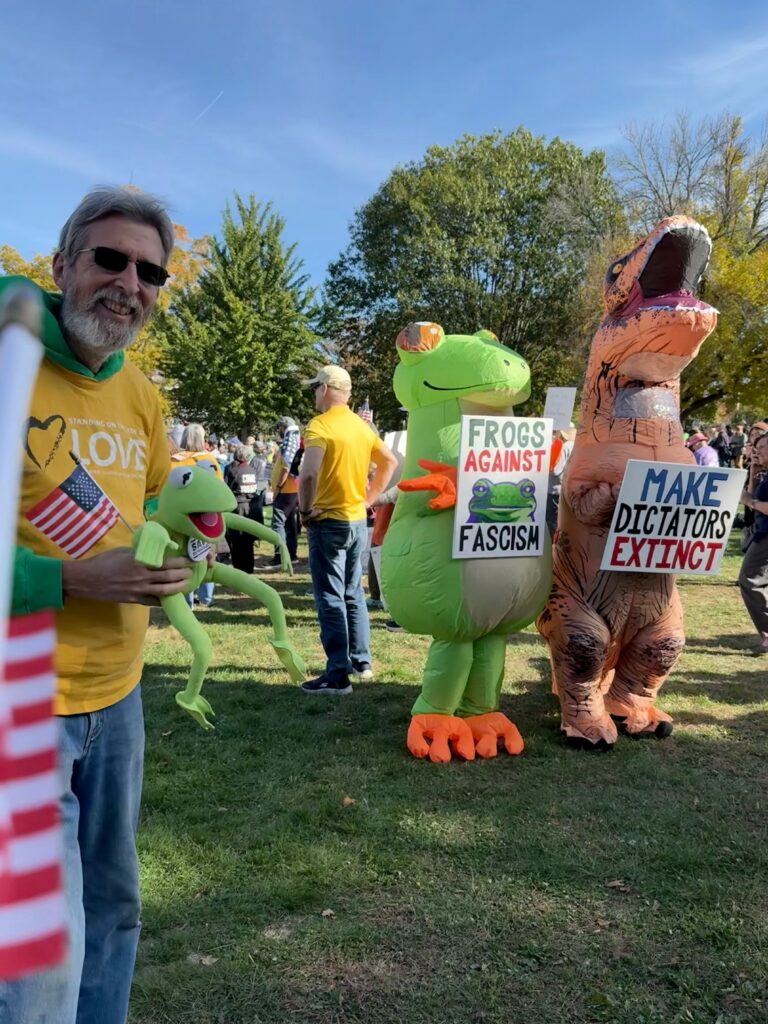
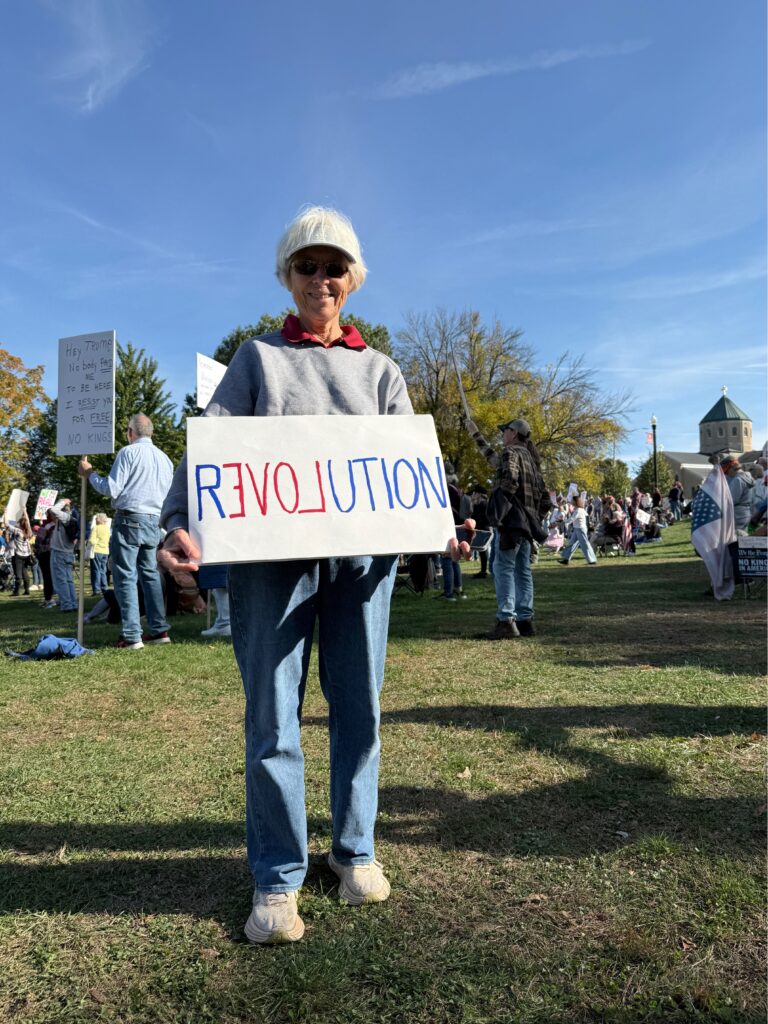
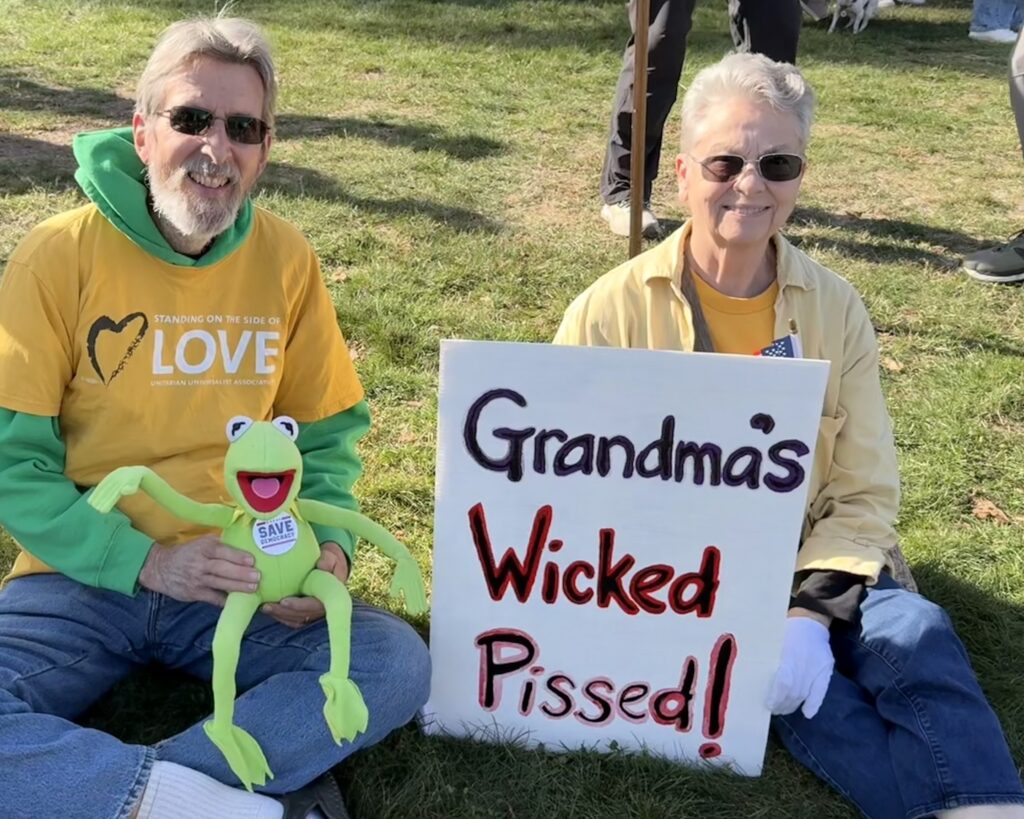
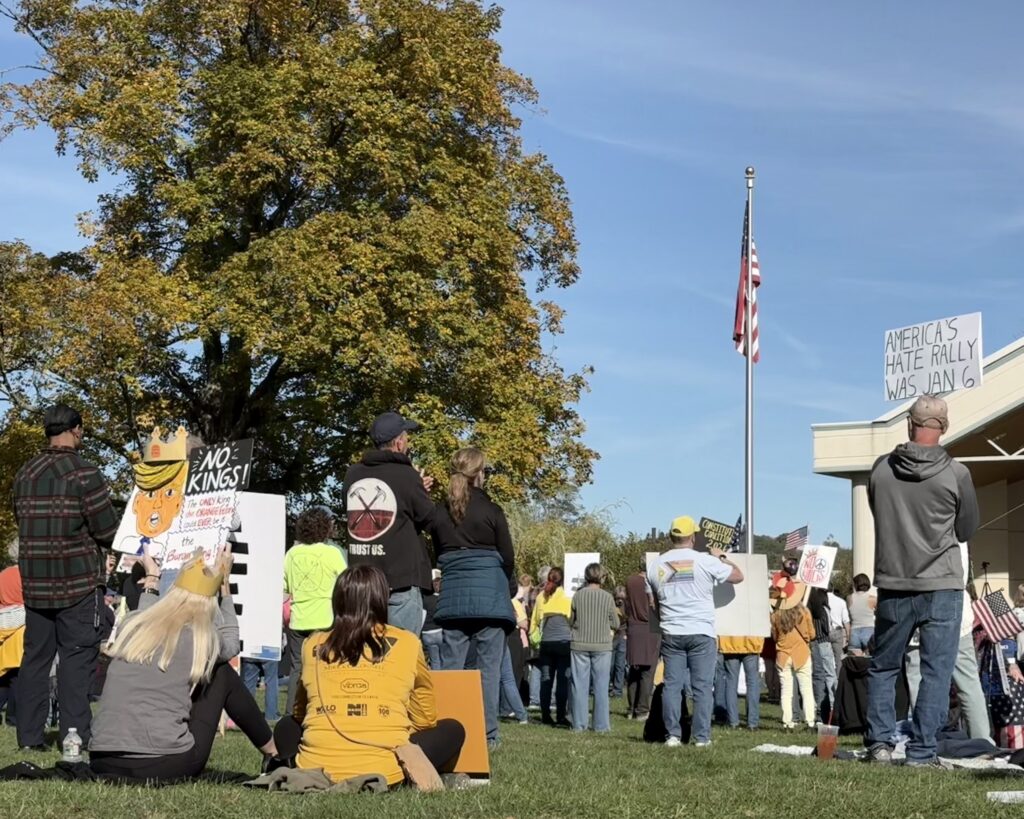
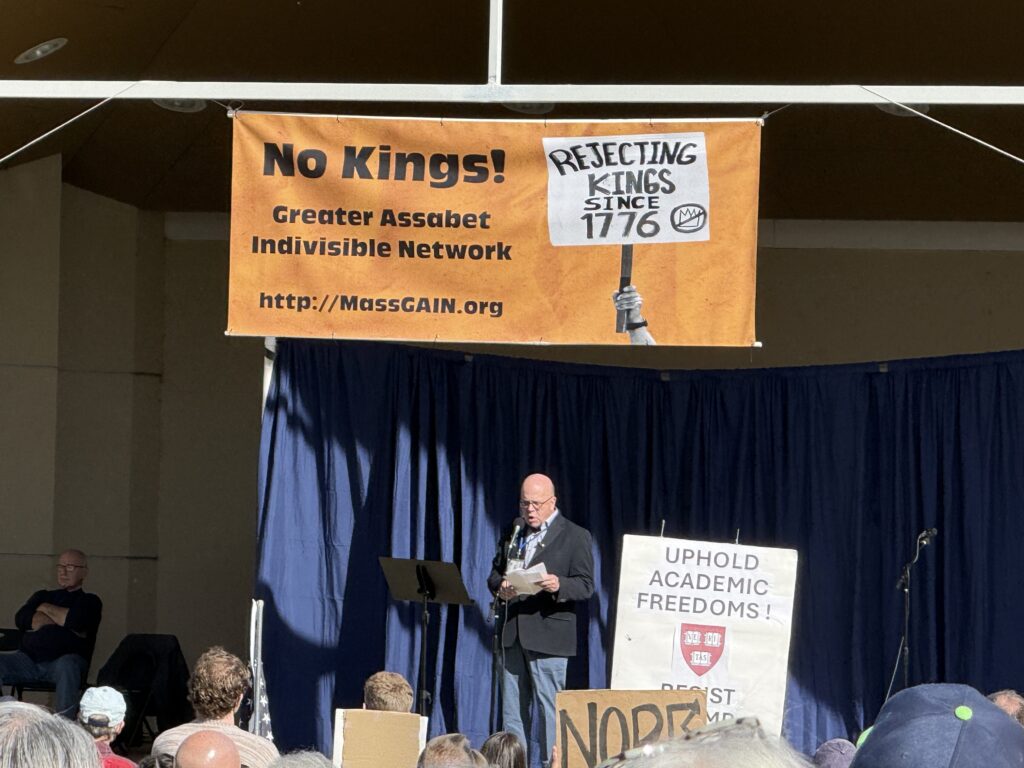
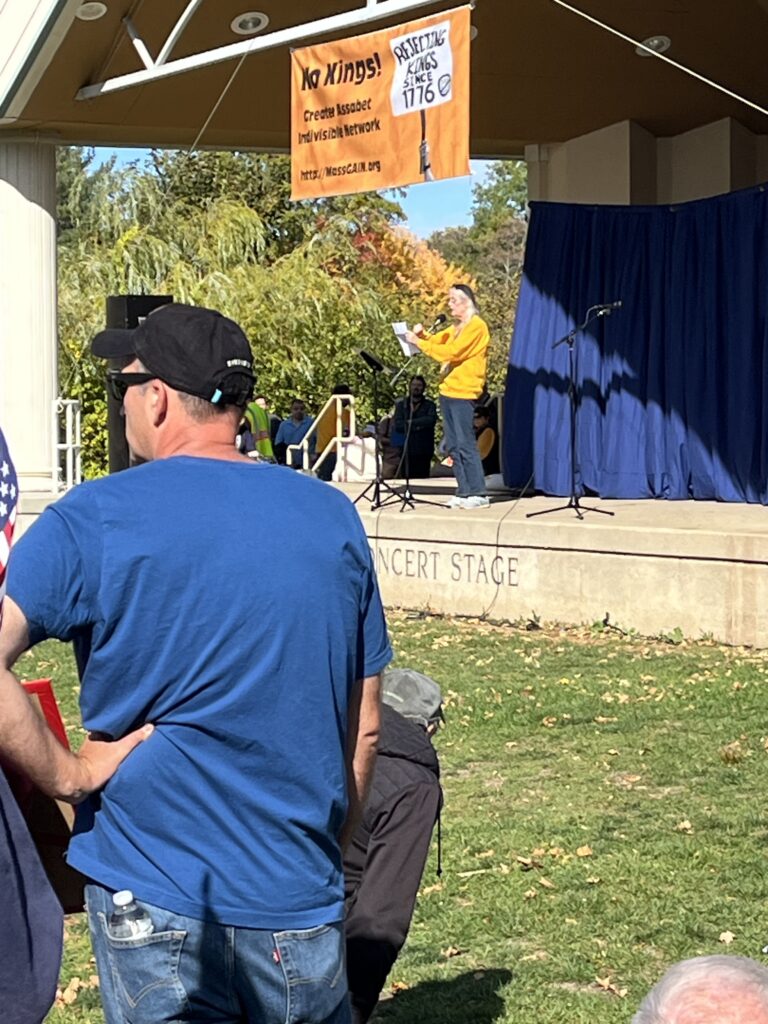
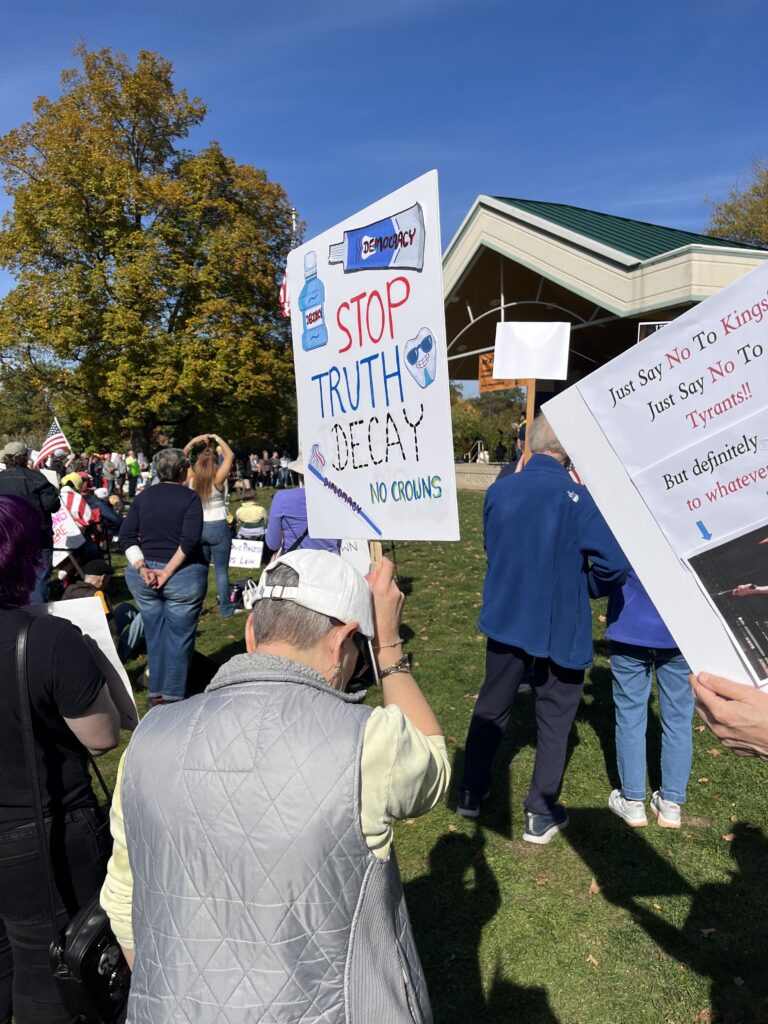
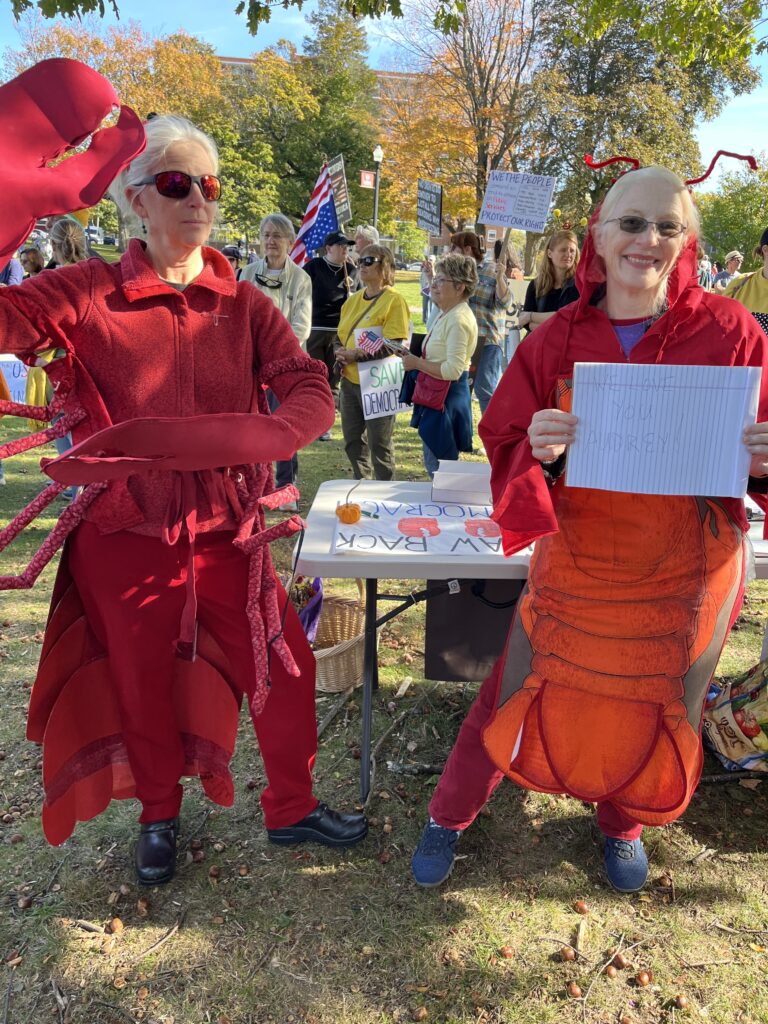
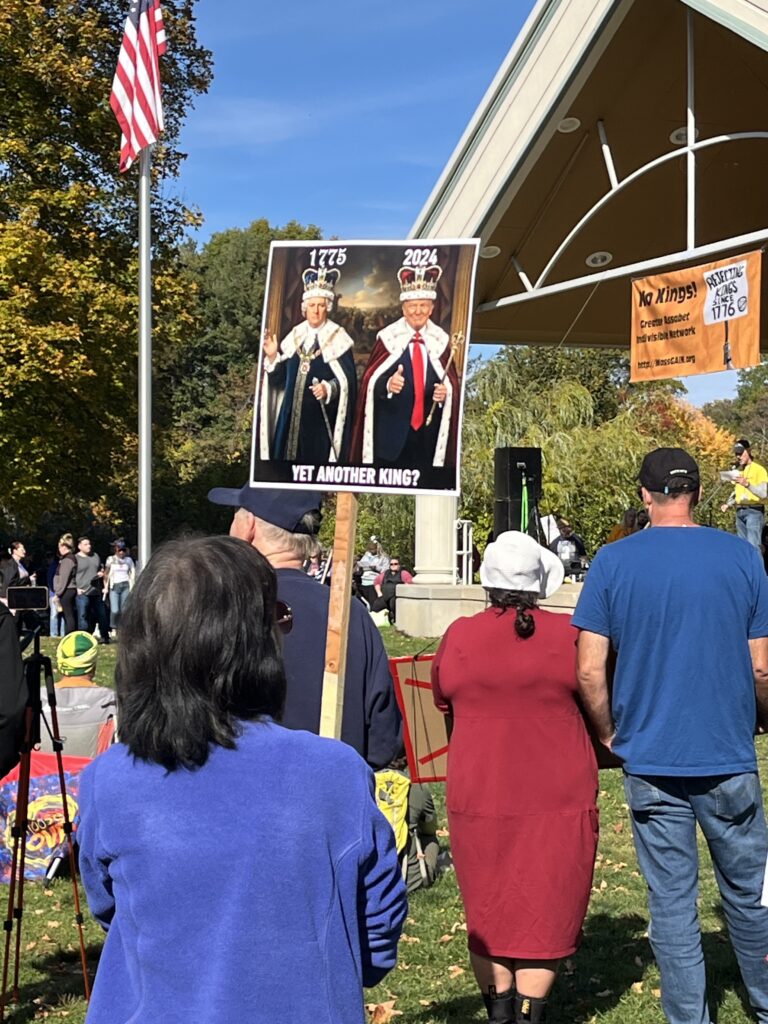
Many First Parish members joined with 7 million others across the USA to stand for democracy and justice for all!


Please see the attached link for helping out at the upcoming Community Meal on Wednesday, Oct 22.
For the Community Meal (taking place at Trinity Church in Northborough) set up starts about 4:45, serving at 6 pm, and clean up at 6:45 pm.
We need volunteers for set up/serving/ clean-up and/or preparing or buying food as well.
Sign up at https://www.signupgenius.com/go/70A084CA5A62BA57-59477432-community#/